
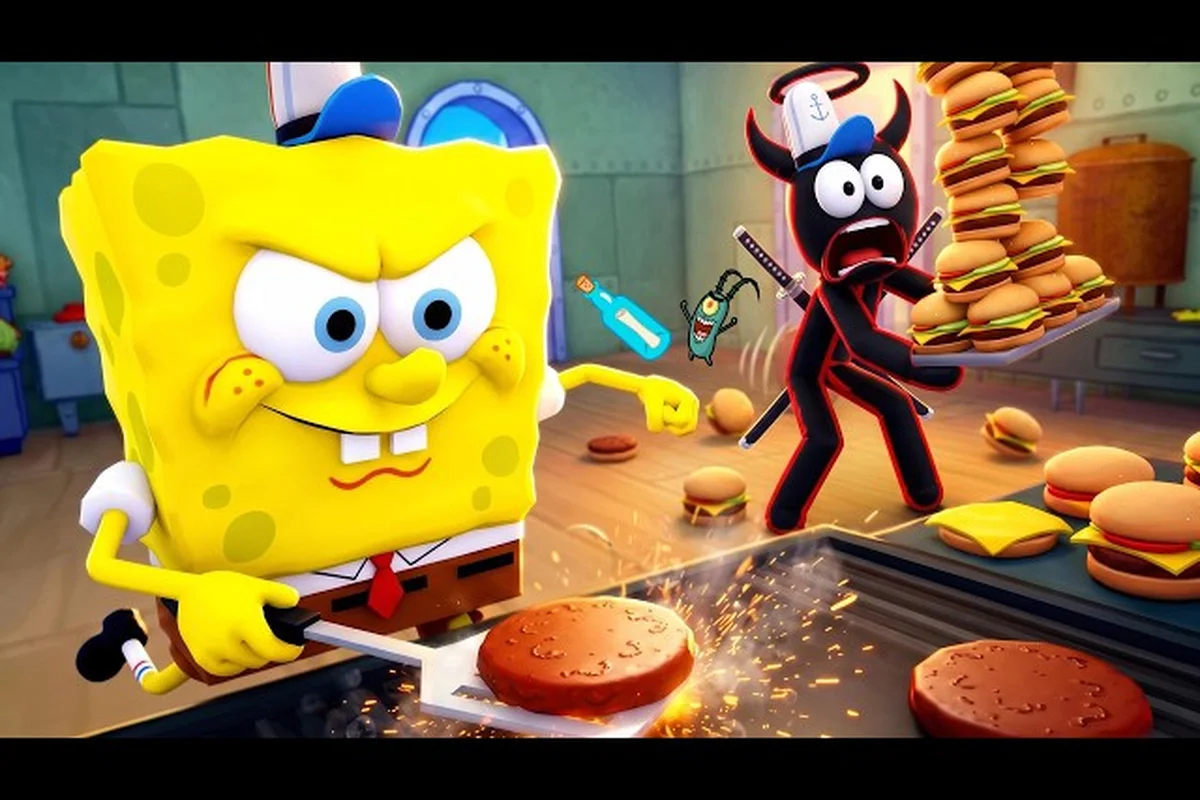
Save the Krusty Krab cleaning assignments keep co-op crews moving instead of having everyone clean the same table. A clear order handoff protects the shared cash bonus and turns a scattered group into a coordinated kitchen.
Why Cleaning Assignments Matter in Co-op
Cleaning is a production task disguised as a chore. When a customer leaves a messy table, that table may not be available for the next order, while the worker who cleaned it may also have been the only person watching the grill or drink station. In multiplayer, assigning cleaning jobs prevents duplicated effort and gives every player a useful responsibility during the busiest moments.
Community field notes for Save the Krusty Krab cleaning assignments report that experienced public-server groups agree on stations before clocking in instead of improvising after the first rush. That approach matters because the game has no built-in role assignment system, so communication and visual signals carry the responsibility. A quick plan before the rush is often more valuable than a complicated strategy afterward.
The core objective is simple: clean the tables that are blocking service, then return to your primary station. The best arrangement depends on the number of players, the class lineup, and whether the crew is using a shared cash bonus objective. Players should understand the difference between a primary role, a backup role, and a temporary handoff before the first order arrives.
| Crew situation | Primary cleaning rule | Backup rule | Main benefit |
|---|---|---|---|
| Duo | One player owns tables while the other protects the main service station | The station owner cleans only when the queue is clear | Fewer abandoned orders |
| Trio | Assign tables, cooking, and drinks in a fixed rotation | One player handles overflow cleaning | Better coverage during rushes |
| Three-player team | Keep one flexible worker near the dining area | Flexible worker supports the station with the largest delay | More balanced workload |
| New or mixed team | Use simple verbal labels before the rush | Anyone may clean when clearly marked | Fewer role misunderstandings |
These rules are not official universal settings. They are practical team agreements based on the publicly documented absence of a formal assignment interface. Exact bonus percentages, customer timers, and difficulty thresholds should not be treated as fixed values unless confirmed by the current game build.
Assigning Stations Before the First Order
The cleanest setup starts before the rush. Decide who handles tables, who protects the order path, and who covers the secondary station. The names can be short and functional: Table Runner, Order Guard, and Flex Cleaner. These labels work in chat, voice communication, or simple in-game signals.
For a duo, give the table-running job to whichever player can move between the dining area and service counter without repeatedly abandoning a critical station. The other player should focus on producing or delivering orders. If both players are carrying comparable tools, the more mobile player usually makes the better table runner, although this should be adjusted for class abilities and control comfort.
For a trio, avoid assigning cleaning by elimination. Instead, create a fixed division of labor. One player owns the dining area, one owns the main production station, and the third handles drinks or overflow deliveries. The flexible role is not an excuse to wander; it is a reserve lane that activates when a specific problem appears, such as a growing table queue or a delayed order handoff.
| Assignment label | Player action | What the player should not do |
|---|---|---|
| Table Runner | Clear dirty tables and check for newly dirty tables | Abandon the only active production station |
| Order Guard | Confirm completed orders and direct the handoff | Start cleaning without announcing the transition |
| Flex Cleaner | Handle overflow tables and emergency spills | Take over another player’s permanent role |
| Station Owner | Maintain one specific production area | Assume someone else will notice a delayed item |
A useful pre-rush checklist is to name the stations, identify the table owner, set the first handoff phrase, and decide what happens when a player disconnects. It is also useful to review the difficulty curve and crew strategy guide because later stages may demand a tighter division of labor than the opening shift.
Order Handoff Without Wasting a Shift
A smooth Save the Krusty Krab order handoff needs two things: a clear destination and a clear completion point. The player preparing an order should know where the finished item goes, and the next person should know when the item is ready. Without that shared understanding, a finished order can sit on a counter while both players assume the other player will move it.
Use a three-part handoff whenever possible: name the item, name the destination, and confirm the receiver. For example, “One burger to the counter, I’ll bring the drink.” This is more useful than calling out the entire station, especially when the kitchen becomes crowded. If voice communication is unavailable, assign a visual cue that is unlikely to be confused with normal customer activity.
The receiving player should respond only when the order is physically secured. That prevents duplicate pickups, accidental returns, and wasted movement. If the team uses a shared cash bonus, the handoff process becomes even more important because uninterrupted service can preserve the crew’s bonus progress. The cash multiplier and fast-order bonus guide explains the broader payout factors that make steady order flow valuable.
| Handoff situation | Recommended action | Delay prevention |
|---|---|---|
| Item is ready but the route is crowded | Announce the destination before moving | Prevents wrong-way pickups |
| Two players finish nearby orders | Assign one to deliver and one to clear the path | Avoids duplicate movement |
| Table becomes dirty during service | Table owner handles it immediately | Keeps seating capacity available |
| A station owner must clean | Name a temporary replacement first | Prevents an abandoned station |
| Crew member disconnects | Flex player absorbs the abandoned role | Maintains basic coverage |
Good handoffs are not about speaking more. They are about reducing uncertainty. A short phrase that confirms destination and ownership is usually more valuable than a long explanation after a mistake. If the team is still learning, the money guide can help identify which service patterns are worth protecting when cash is the main goal.
Protecting the Shared Cash Bonus
A Save the Krusty Krab shared cash bonus depends on coordinated service rather than one player carrying the entire shift. A crew that leaves half its tables dirty may still complete orders, but the resulting delays can interrupt the rhythm that produces a stronger result. The goal is to keep tables available and orders moving without creating a second pile of unfinished work.
The Save the Krusty Krab crew cash bonus should be treated as a team target. Each player should understand which actions support the objective: clearing a table quickly, confirming a handoff, and returning to a primary station after finishing a temporary task. A player who cleans one extra table but abandons the grill for too long may reduce the team’s overall performance rather than improve it.
The key distinction is between productive cleaning and visible cleaning. Cleaning a table that is blocking a customer is productive. Cleaning a distant table while a line of customers waits is not. Apply the blocking rule in this order: first remove the obstacle to service, then clean nearby tables if time allows, then return to your assigned station.
| Cleaning decision | Choose this when | Expected crew effect |
|---|---|---|
| Clean a table blocking a customer | A customer cannot be seated or served | Restores service capacity |
| Clean the nearest dirty table | The dining area is otherwise clear | Prevents a backlog |
| Clean a distant table | All immediate tables are open | Usually lower priority |
| Delay cleaning | Your station is about to produce a rush | Protects order flow |
| Switch temporarily | A teammate calls for help | Restores balance without role drift |
Because the exact bonus formula is not published in the supplied community notes, avoid promising a specific percentage. A practical way to evaluate the arrangement is to compare successful shifts: note when tables were cleaned, how many handoffs were delayed, and whether the cash result improved. For more detail on payout priorities, see the no-mistake bonus breakdown.
Best Duo Classes for a Two-Player Crew
The best duo classes are not simply the two highest-ranked options. A pair should cover different responsibilities, remain useful when one player is cleaning, and avoid making the other player responsible for every task. The complete classes list is useful for checking the available options, but the crew’s communication habits matter as much as the class ranking.
For a duo, the strongest arrangement often pairs a reliable production specialist with a flexible table runner. The production specialist protects the station, while the other player keeps the dining area moving. If both classes are excellent at serving but weak at mobility, tables may accumulate faster than the team can clear them. If both classes are mobile but lack a strong production specialty, the opposite problem appears.
| Duo structure | Main role | Secondary role | Best when |
|---|---|---|---|
| Production plus mobility | Produce and protect one station | Clean tables and collect orders | The team wants stable order flow |
| Two flexible specialists | Share stations by rush type | Switch when one area backs up | Both players prefer adaptability |
| Two production-heavy classes | Alternate production tasks | Clean only during a lull | The pair can maintain speed without cleaning |
| New-player pair | One player announces priorities | The other confirms handoffs | Communication needs support |
Test a pair during a normal shift before treating it as a permanent answer. The Save the Krusty Krab best duo classes choice should be judged by coverage, response time, and table availability, not by a single class’s individual strength. If the team’s priority is money, use the pair that protects the shared cash bonus without forcing either player to cross the kitchen unnecessarily.
The Best Trio Setup for Busy Shifts
A three-player crew can divide the restaurant into three lanes, but only if the lanes remain understandable. The best trio setup has one table owner, one production owner, and one flexible worker. Each lane should have a clear default, while the flexible worker handles overflow rather than repeatedly changing jobs.
For example, the table owner can check the dining area after each order, the production owner can focus on cooking, and the flexible worker can deliver completed items, assist with drinks, or clean when tables begin to stack. This arrangement supports the Save the Krusty Krab order handoff because every finished item has a designated next destination.
| Trio role | Default responsibility | Escalation condition |
|---|---|---|
| Table Owner | Clear dirty tables and keep seating moving | Dining area begins to back up |
| Production Owner | Maintain the main production station | A rush of orders forms |
| Flex Worker | Deliver, assist drinks, and cover overflow | A teammate leaves or falls behind |
| Temporary Support | Handle one defined task until relieved | Handoff is confirmed by the new owner |
The Save the Krusty Krab best trio setup should be tested with a short communication drill. Before the rush, every player should point to their default station and state the exact condition that will make them switch. “When there are more dirty tables than open seats” is more useful than “when things get busy,” because everyone can recognize the trigger.
| Trigger | Player response | What to avoid |
|---|---|---|
| Two or more dirty tables block service | Table owner cleans immediately | Both players leaving production |
| One station produces faster than delivery | Flex worker assists that station | Flex worker abandoning all other jobs |
| An order is waiting at the counter | Named receiver collects it | Assuming the nearest player noticed |
| A player disconnects | Flex worker takes over | Leaving two roles permanently vacant |
| Cleanup temporarily exceeds one player’s capacity | Another player takes the overflow | Switching without an announced handoff |
The trio works best when roles remain stable during ordinary service and change only when a visible condition occurs. This prevents the team from turning every order into a negotiation. Keep the role chart short enough to memorize, but review it when the crew composition changes.
Practice Drills and Platform Coordination
Cleaning assignments can be rehearsed without starting a full shift. A private practice session or a low-pressure public-server round can be used to test signals, station ownership, and the response to a forced role change. The goal is to make the crew’s first real rush feel routine rather than improvised.
Community observations also note that Roblox’s PC, mobile, tablet, and console support implies cross-platform play, although there is no separate crossplay toggle in the current build. Control differences matter most for mopping and pouring: both actions are generally easier with a mouse than with a touchscreen. Players using touch controls should choose a station that requires fewer precise movements or use a tap-first handoff that reduces dragging and menu management.
| Control situation | Assignment recommendation | Communication style |
|---|---|---|
| Mouse and keyboard | Full table-running duties | Short text or voice cues |
| Touchscreen | Stable station with simple inputs | Large visual signals |
| Mixed devices | Pair mobile-friendly tasks with mouse precision | Redundant visual confirmation |
| Console controller | Assign by comfortable movement range | Repeat handoff destination |
| Inconsistent connection | Give flexible player the most portable tasks | Build in recovery time |
The best practice drill is to record a short checklist after the shift. Mark which table blocked service, which handoff caused a delay, and whether the flexible player was overloaded. Do not invent precise timing thresholds from one round; use the notes to identify recurring friction. The game’s official information remains the best source for confirmed mechanics, while the supplied community field notes for Save the Krusty Krab cleaning assignments offer observations that should be treated as community experience rather than official rulebook data.
Frequently Asked Questions
Should one player always handle every table in a duo?
No. A permanent table owner is useful only when the other player can protect the active production station. If the designated cleaner becomes overloaded, the other player should take one overflow table or announce a temporary handoff. The goal is to keep service moving, not to preserve a rigid title.
When should the crew switch to a flex cleaner?
Switch when a specific bottleneck appears, such as dirty tables blocking new customers or one station receiving more orders than the others can deliver. A clear trigger prevents constant role switching. Announce the change, complete one task under the new role, and then return to the default assignment when the pressure clears.
Does cleaning need to happen before taking another order?
Only when a dirty table is blocking service or the team’s bonus objective makes immediate cleanup necessary. Otherwise, taking a ready order may be better than leaving completed food waiting. In a duo, the table runner should handle urgent tables while the station owner continues production, keeping both duties from collapsing onto one player.
Which duo classes work best with cleaning assignments?
The most effective pair combines a dependable production specialist with a mobile player who can clear tables and confirm handoffs. Two equally strong production classes can work, but they may leave the dining area vulnerable. Compare each pair by table availability and delivery delays rather than ranking the classes in isolation.
Can a trio use the same assignment system as a duo?
Yes, but add a dedicated flex role. The trio should assign tables, production, and flexible support so no task has no clear owner. The flex player can absorb cleaning, delivery, or drinks depending on the visible bottleneck, while the other two players remain anchored to their primary stations.
A strong Save the Krusty Krab cleaning assignments plan is simple to state, easy to repeat, and flexible when pressure changes. Name the table owner, protect the active station, announce each handoff, and use the flex worker only for a clear reason. That coordination gives duo and trio crews more reliable service while helping preserve the shared cash bonus.