
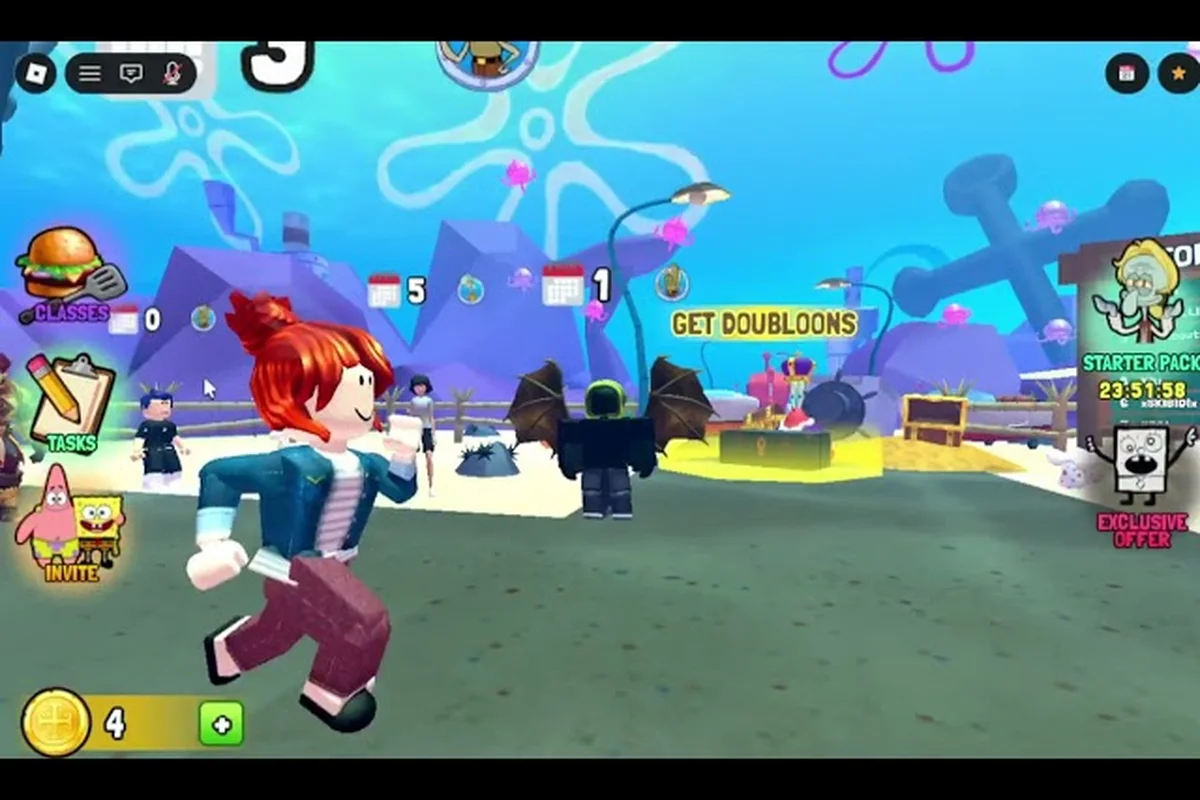
A strong Save the Krusty Krab support class guide matters because every station has a different bottleneck: a cook can keep orders moving, but a cashier who cannot process quick payments will still create a queue. Assigning the right support roles lets the team cover cooking, orders, cleanup, security, and table service without overloading one worker, reducing wasted patties, delayed customers, and frustrated shifts.
Compare each Save the Krusty Krab support role by its operational bottleneck, then size the team around simultaneous demands. Cooks keep patty production and order flow moving, cashiers speed up payment processing, servers handle table orders, janitors prevent cleanup from interrupting service, and security controls hazards without pulling staff from the line. For example, a busy lunch rush may need extra cooking and cashier coverage, while a customer-heavy shift benefits from stronger server and janitor support; matching staffing to the current rush prevents wasted patties, delayed orders, and overworked workers.
Support Class Role Breakdown
Support classes work best when their strengths cover separate parts of the restaurant. A capable cook cannot prevent a dirty floor, a fast cashier cannot supervise every table, and a security worker cannot fix a burned patty. The useful comparison is therefore based on station coverage, not just overall tier placement.
Community field notes currently list ten playable classes: SpongeBob, Mr. Krabs, Squidward, Patrick, Sandy, Gary, Larry, Pearl, Jim, and Fred. Fred is the free starter, while the remaining classes require doubloons. Community tier lists commonly place SpongeBob and Mr. Krabs in S tier, Gary, Sandy, and Jim in A tier, Pearl, Patrick, and Larry in B tier, Squidward in C tier, and Fred in D tier.
| Class | Primary support area | Best crew value | Common limitation |
|---|---|---|---|
| SpongeBob | Cooking | Multi-pattie grill capacity | Needs another class to cover service gaps |
| Mr. Krabs | Cashier or management | Register speed and business pressure | Limited help outside the front-of-house role |
| Gary | Cleaning and sanitation | Handles recurring floor messes | Better as cleanup coverage than a universal helper |
| Sandy | Security and enforcement | Protects against disruptive customers | Not designed to replace cooking or service |
| Jim | Cooking | Faster patty preparation | Leaves other stations uncovered if used alone |
| Squidward | Service or front-of-house | Flexible customer-facing work | Community ratings suggest weaker overall efficiency |
| Pearl | Serving | Moves food and clears tables | Better paired with a dedicated register worker |
| Patrick | Service support | Assists with customer-facing tasks | Less specialized than a class with a station gimmick |
| Larry | Security support | Adds another enforcement-oriented body | Can be redundant when Sandy is already present |
| Fred | Starter coverage | Available without doubloons | Lower community tier and limited specialist value |
The exact customer bonus, patience window, energy cap, and character rank formula are not consistently published. Treat precise percentages or timers outside official information as community observations rather than fixed rules. When comparing a cook with Gary, Mr. Krabs, or Sandy, compare station coverage and the support effect each class provides, not a single tier number; community notes may describe relative performance, but they do not establish a universal stat formula.
What Counts as Good Station Coverage?
Useful coverage answers four practical questions: Can the crew keep food coming, clear orders quickly, maintain a clean dining room, and discourage troublemakers? It also prevents everyone from converging on one station that appears visually busy while a less noticeable chore piles up elsewhere.
-
Food production: Keep the grill assigned to a cook with a relevant passive.
-
Order handling: Use a cashier who can process transactions without being pulled into cleanup.
-
Dining-room upkeep: Assign someone to collect messes and reset tables.
-
Customer safety: Place a security-oriented class near disruptive customers.
-
Table service: Have a server handle food delivery and table clearing.
-
Management: Keep a flexible leader available for reassignment during surges.
Because stations compete for attention, review the Save the Krusty Krab class unlock priority before spending doubloons. The order can be more valuable than a narrow tier ranking because a balanced four-person crew may outperform four individually strong characters who crowd the same task.
Cooking Class Comparison for Save the Krusty Krab
Cooking determines how quickly the kitchen can turn customer orders into finished patties. The relevant question is not simply which class has the highest community tier, but which player can keep the grill moving without leaving the cashier, dining room, or service lane unattended.
SpongeBob Versus Jim at the Grill
Community testing reports that SpongeBob can prepare two patties simultaneously with automatic flipping. At level 2, that increases to three, and at level 3 it reaches four. The effect appears to apply to the crew grill rather than only to SpongeBob, making his passive unusually valuable when teammates share the same cooking station. Jim cooks patties 25 percent faster and begins each shift with three kelp shakes.
| Cooking factor | SpongeBob | Jim | Practical meaning |
|---|---|---|---|
| Cooking passive | Multiple patties with automatic flipping | 25 percent faster patty cooking | SpongeBob favors volume; Jim favors speed |
| Starting support item | Not specified in the available data | Three kelp shakes | Jim has a useful opening service option |
| Crew contribution | Effect reportedly reaches the shared grill | Personal preparation speed | SpongeBob can improve the entire kitchen |
| Best placement | Dedicated grill plus occasional backup | Main grill while another player handles orders | The pair covers different forms of cooking pressure |
| Community standing | S tier | A tier | SpongeBob is the stronger general pick |
SpongeBob is the safer investment for a cooperative crew because his level-dependent patty capacity benefits the shared crew grill even when another player handles the orders. For example, the level 2 grill can prepare three patties with automatic flipping, allowing SpongeBob to cover a rush without occupying the cashier or server role. Jim becomes more attractive when the crew already has reliable cleanup, cashiering, and service coverage; his 25 percent cooking speed and three starting kelp shakes can then add pressure-solving value without requiring him to cover the station’s weaker support roles.
Cook Class Comparison by Crew Size
A solo player should choose the cook that minimizes interruptions. A cook who can generate several patties at once can cover the grill while the player steps away to take an order, but a player still must actively return to the grill because unattended food can burn. In a two-player crew, the best arrangement is usually one dedicated cook and one rotating support worker.
| Crew situation | Recommended cooking setup | Reason |
|---|---|---|
| Solo play | SpongeBob, with Jim as an alternative | Multi-pattie capacity provides more room to handle other chores |
| Two players | Dedicated SpongeBob plus a flexible partner | One player protects the kitchen while the other rotates |
| Three players | SpongeBob, cashier, and one floater | Keeps each essential station covered |
| Four or more players | SpongeBob at grill, Jim as secondary cook | Adds output without removing cashier, cleaner, or security coverage |
| Mixed skill levels | SpongeBob with an experienced partner | The partner can cover orders while SpongeBob manages patties |
Jim becomes a strong secondary cook in a larger group, yet adding him does not automatically solve a missing cashier or dirty-table problem. The Save the Krusty Krab class level up guide is useful here because each class progresses from level 1 to level 3 with XP earned during shifts. Community reports place daily XP near 20 points, so reaching maximum level is a long-term objective rather than an early-game requirement.
Cashier, Janitor, and Server Class Roles
The front and back of the restaurant need different traits. A cashier should remain near transactions, a janitor should patrol the dining room, and a server should keep food moving between the kitchen and customers. Combining these jobs under one player can work in a small crew, but it creates movement delays whenever the restaurant gets busy.
Cashier Class Options
The Save the Krusty Krab cashier class guide should prioritize constant order processing and front-of-house control. Mr. Krabs is the clearest dedicated choice because his role revolves around money and tables. Community notes also mention a second table at higher levels, although exact acquisition and activation conditions are not published in the available data.
| Cashier candidate | Best reason to use | What to watch |
|---|---|---|
| Mr. Krabs | Strong business-role identity and dedicated front-of-house value | May need support with deliveries and cleanup |
| Squidward | Can handle a register during a smaller, orderly shift | Lower community ranking may reduce value in crowded scenes |
| Any flexible class | Can cover brief rushes when no specialist is free | Lack of a register-specific passive makes it a temporary solution |
| Sandy | Suitable only if no dedicated cashier is present | Security value is wasted at the register |
A dependable cashier should remain at the register until the order queue becomes a visible problem. Then the manager can move a server, Patrick, or another flexible teammate forward temporarily. Avoid rotating cashiers too quickly, because unfamiliar movement can create as many delays as the queue it is meant to solve.
Janitor Class Options
Gary is the clearest cleanup specialist in the available class list. The Save the Krusty Krab janitor class guide should focus on dirty tables, floor messes, and recurring sanitation work. A cleaner works best on a patrol schedule: check the dining area, handle the nearest mess, then move to the next visible issue.
| Cleanup situation | Better assignment | Why |
|---|---|---|
| Frequent table spills | Gary | Cleaning is his clearest specialist identity |
| Mixed dishes and trash | Any available support class | Task completion matters more than title while Gary handles harder messes |
| Server overwhelmed by tables | Gary plus one server | They divide cleanup and delivery work |
| Solo shift with dirty customers | Flexible class with quick movement | Gary is valuable, but one player still needs to alternate stations |
Server Class Options
Pearl provides the most direct service-oriented option, while Patrick can assist with general customer-facing work. The Save the Krusty Krab server class guide should treat servers as a bridge rather than a replacement for either kitchen or cleanup. A strong server delivers meals, clears tables, and communicates customer needs without abandoning assigned stations.
A practical crew can assign Pearl to deliveries and Gary to sanitation, leaving Mr. Krabs at the register and SpongeBob or Jim at the grill. Patrick becomes a flexible substitute when a server is occupied or when customers spread across multiple tables. For more ideas on balancing grill and register assignments, the Save the Krusty Krab support-class breakdown provides useful role-splitting context.
Security and Service Class Priority
Security and service handle different forms of disorder. Security controls customers who disrupt service, stall tables, or ignore rules. Service keeps food and table turnover moving. A crew that hires only one of these roles can still develop a visible bottleneck in the other.
Security Class Options
Sandy is the strongest specialist choice for the Save the Krusty Krab security class guide. Larry can provide additional enforcement coverage, but two security-focused characters are most useful when the restaurant regularly handles hostile customers. With only a small crew, one security specialist plus several service workers generally produces a better station spread than two security classes and no server.
| Security situation | Recommended coverage | Alternative |
|---|---|---|
| One disruptive customer | Sandy at the relevant table | Larry for a smaller, less demanding crew |
| Several hostile customers | Sandy plus one flexible teammate | Add Larry only if cleanup and service are covered |
| Mostly calm customers | One security character only | Let another class handle flexible duties |
| Solo player | Use security only when the customer becomes disruptive | Pause another task to resolve the immediate issue |
Do not invent fixed spawn schedules or universal customer reactions. The available data does not provide a reliable villain schedule, and community experience indicates that enforcement patterns can vary. Focus on the visible cause of the disruption and respond with the nearest appropriate class.
Prioritizing Service Over Redundant Security
Service usually has a larger effect on shift flow because food must reach customers and tables must reopen. A crew with Gary handling messes, Pearl delivering orders, and Mr. Krabs processing payments needs security only when a customer actively creates disruption. Adding Larry before those roles are covered merely moves the bottleneck to food delivery or sanitation.
| Priority | Class purchase | Coverage gained | Delay if skipped |
|---|---|---|---|
| 1 | SpongeBob | Cooking capacity | Orders wait for prepared food |
| 2 | Mr. Krabs | Cashier performance | Payments and order flow slow down |
| 3 | Gary | Cleanup specialist role | Dirty tables occupy customer capacity |
| 4 | Pearl | Table service and delivery | Food waits at the kitchen |
| 5 | Sandy | Security control | Problem customers can interrupt work |
| 6 | Jim | Faster secondary cooking | Patties take longer when SpongeBob cannot cover volume |
| 7 | Patrick or Squidward | Flexible customer support | The team has less room to rotate |
| 8 | Larry | Additional security | Only valuable after service roles are stable |
This ranking assumes a cooperative crew that can specialize without excessive handoffs. In solo play, the same priority order becomes less useful because one player must cover cooking, cashiering, table service, and cleanup; for example, a SpongeBob-focused build may serve customers quickly but leave dirty tables blocking capacity. Personal speed, task variety, and flexible support skills therefore matter more than a perfect theoretical division of labor, while buying Larry as a security class cannot compensate for unattended food orders or unclean tables.
Building a Complete Support Crew
A complete crew should be arranged around permanent assignments, short rotations, and emergency priorities. Assigning a character permanently to one station does not mean that player must never leave; it means the team knows which role to reclaim first when the player returns.
Recommended Four-Person Setup
For a four-player crew, SpongeBob at the grill, Mr. Krabs at the register, Gary handling cleanup, and Pearl covering service creates a clean division of labor. Sandy becomes the strongest fifth addition because security problems are more disruptive than adding another general helper.
| Player | Main assignment | Secondary duty | Main warning |
|---|---|---|---|
| Player 1 | SpongeBob at grill | Reserve cook | Return immediately to unattended patties |
| Player 2 | Mr. Krabs at register | Cash collection | Do not pull Mr. Krabs into general fetching |
| Player 3 | Gary on cleanup patrol | Table reset | Avoid leaving every mess for the final minute |
| Player 4 | Pearl on delivery | Assist Gary with tables | Keep clear of the register to prevent overlap |
| Optional fifth | Sandy on security | Float to the busiest station | Respond only after basic service remains stable |
Solo and Two-Player Rotation Rules
In a solo shift, cycle through the kitchen, register, dining room, and service lane in that order. SpongeBob’s multiple-pattie capacity gives the most room for rotation, although every patty still needs attention. When a customer becomes disruptive, resolve that issue immediately; otherwise the delay can affect several nearby tables.
Two players should split the restaurant into broad halves. One handles the kitchen and register, while the other covers tables, food delivery, and cleanup. When both players are needed at the grill, pause table work briefly rather than allowing food to burn. This arrangement works because it protects production while maintaining a flexible second worker.
Manager Checklist Before the Rush
-
Confirm that the cook can reach the grill without crossing a congested customer route.
-
Verify that the cashier has an unobstructed view of the register and order area.
-
Assign cleanup before dirty tables begin reducing usable seating.
-
Keep one service player ready to deliver completed food.
-
Use Sandy or Larry when a customer creates a genuine security problem.
-
Rotate flexibly when one player handles a new class, since higher-level abilities may take practice to use efficiently.
Class levels improve their gimmicks, but buying a new character usually changes coverage more immediately than pushing one character from level 1 to level 2. The Save the Krusty Krab day guide can help track how the available crew grows across a run, while the class upgrade guide remains more directly relevant to long-term passive improvements.
Support Class Team Compositions and Testing
The best composition changes with the number of players and the class levels available. Test a lineup on a normal shift before using it as the permanent arrangement. The goal is not to maximize each class’s theoretical ability; it is to keep every essential station functioning without creating a gap.
Composition Comparison
| Crew size | Recommended lineup | Strength | Main weakness |
|---|---|---|---|
| Solo | SpongeBob | Strong cooking output and good personal task variety | Must leave the grill to cover other stations |
| Two players | SpongeBob plus Mr. Krabs | Cooking and payment coverage | Cleanup and deliveries still compete for attention |
| Three players | SpongeBob, Mr. Krabs, Gary | Kitchen, register, and cleanup are covered | No dedicated server or security specialist |
| Four players | SpongeBob, Mr. Krabs, Gary, Pearl | Broad, balanced service coverage | Security remains reactive |
| Five players | Add Sandy | Full core coverage plus disruption control | Extra players can create unnecessary task switching |
| Six or more | Add Jim, Larry, Patrick, or Squidward | Redundancy and flexible task coverage | Overstaffing can crowd stations and waste time |
Evaluating a Lineup
Use three visible measures during a test shift: food waiting at the grill, customers waiting for service, and tables blocked by messes. If food piles up, move a flexible teammate to the cook. If tables remain dirty, Gary should receive priority. If customers wait despite completed patties, add or reposition a server.
Avoid measuring success through a single star score alone. The available data does not establish a reliable formula connecting customer stars to exact class values, so station flow provides better evidence. Community observations can still support comparisons, but they should remain framed as testing rather than official rules.
What to Do After a Weak Shift
Diagnose the first persistent bottleneck instead of changing the whole crew. If the cook is constantly behind, a faster or multi-pattie passive may help. If the register is delayed, move Mr. Krabs there. If a server repeatedly crosses the restaurant, ask that player to handle only nearby tables. If security disrupts the schedule, assign Sandy before adding another general worker.
A community gameplay class breakdown by RDMVigilance provides an additional example of testing class progression and abilities in play. Treat its results as community experience, especially since builds can change and the video should not be read as a source for unpublished star formulas or exact patience timers.
Frequently Asked Questions
What is the best support class in Save the Krusty Krab?
SpongeBob is the strongest general choice because his multi-pattie ability reportedly affects the crew grill. Mr. Krabs, Gary, Pearl, and Sandy form a balanced crew around him by adding cashiering, cleanup, serving, and security. For solo play, prioritize personal usefulness rather than assembling a theoretical team.
Who is the best cook for a cooperative crew?
SpongeBob offers the better community-reported grill contribution, especially when another player can stand beside the grill and keep patties moving. Jim cooks 25 percent faster and begins with three kelp shakes, making him a strong secondary cook. A dedicated SpongeBob with Jim as backup is ideal for a four-player crew.
Should a small crew buy two security classes?
Usually not. Buy Sandy first, then cover cooking, cashiering, cleanup, and serving before adding Larry. Security matters when customers actively disrupt service, while general service roles affect normal shift flow. Two security classes are useful in larger crews or against frequent hostile-customer situations, not as a substitute for essential coverage.
Can one class handle every station in a solo shift?
A generalist may cover the basic duties, but cooking remains the most difficult station to leave safely because unattended patties can burn. SpongeBob’s higher patty capacity creates more flexibility, yet the player must return frequently. Gary, Mr. Krabs, Pearl, and Sandy remain valuable because they reduce the time required for cleanup, payments, deliveries, and disruption.
How should support classes be assigned during a busy shift?
Keep a permanent primary role for each player and use a flex worker to cover temporary overflow. Start by checking the grill, register, dirty tables, food deliveries, and disruptive customers in that order. If several problems appear simultaneously, assign the most specialized available class and keep others moving rather than crowding one station.