
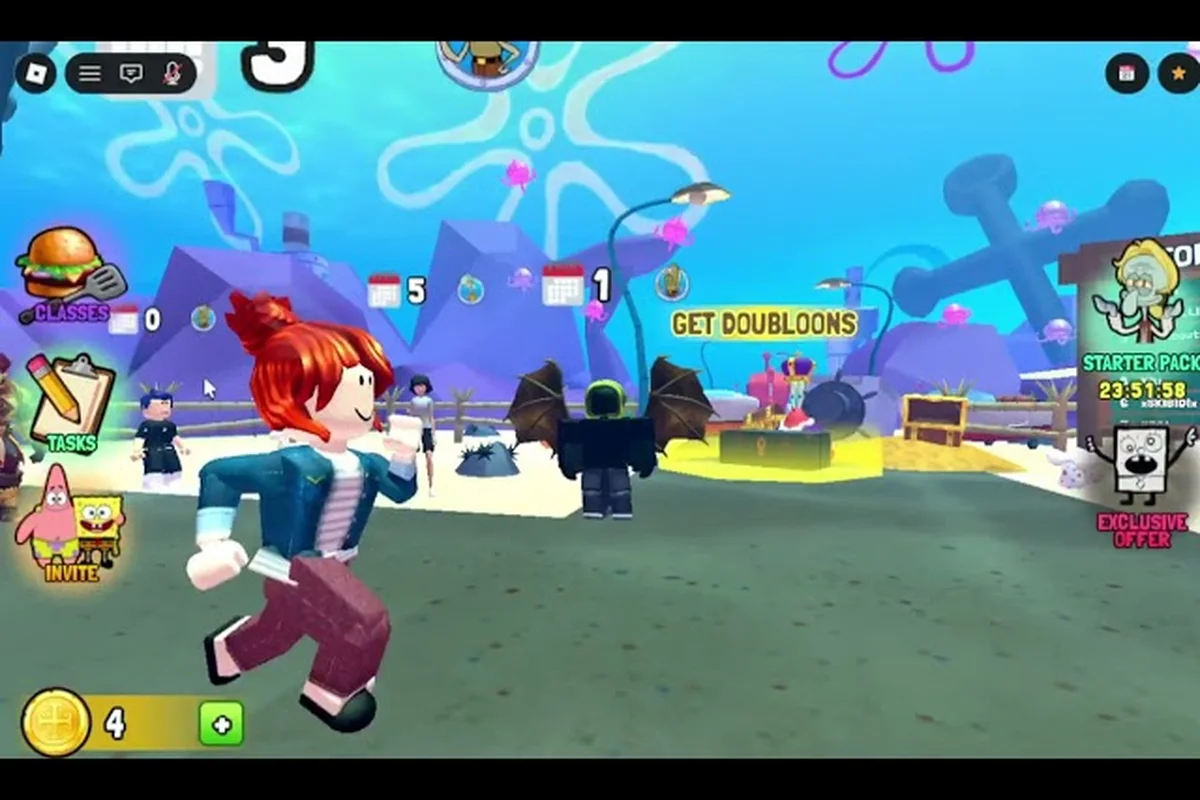
Save the Krusty Krab class level up matters because each promotion improves a worker’s signature ability, turning familiar shift tasks into stronger tools. This guide maps the three-level path, expected daily XP, promotion badges, and the strongest choices for solo play or a busy squad.
During the class level up in Save the Krusty Krab, the video walkthrough demonstrates the available data and gameplay mechanics, providing a visual reference for the class upgrade process (Save the Krusty Krab class level up video).
Class Level Up System Overview
Save the Krusty Krab class level up follows a three-tier progression path. Every playable worker starts at level 1, earns experience by completing shifts, and advances through levels 2 and 3. Community field notes put daily XP near 20 points, making level 3 a long-term goal rather than something a new player reaches in one session.
The important distinction is that the badge represents progress, while the class mechanic determines what that progress improves. SpongeBob, for example, can gain extra patties as he levels, while Mr. Krabs can improve table handling. The current build contains ten classes: SpongeBob, Mr. Krabs, Squidward, Patrick, Sandy, Gary, Larry, Pearl, Jim, and Fred.
| Progression element | Verified information | Practical meaning |
|---|---|---|
| Starting tier | Level 1 | Every class begins with its base ability |
| Middle tier | Level 2 | Adds one stage of class-specific improvement |
| Highest tier | Level 3 | Activates the class’s strongest reported improvement |
| Progression activity | Earn XP by working shifts | Active service is the primary XP source |
| Daily XP estimate | About 20 points, based on community reports | Reaching level 3 takes sustained play |
| Progression record | Promotion badge | Shows which level a class has reached |
| Visible roster | 10 playable classes | Choices include starters, unlocks, and premium characters |
The best class for squads often differs from the strongest solo worker, so leveling should match your preferred play style rather than one universal ranking. Use the class unlock priority overview to compare the roster, then choose the worker whose upgrade supports your normal routine.
What Changes at Each Class Level
Level 1 establishes the baseline class gimmick. At level 2, the worker gains a meaningful improvement to that gimmick, and level 3 supplies the final tier. The exact upgrade depends on the character, so the progression goal is not merely a larger number; it is a more effective way to perform the station assigned to that class.
| Level | Progression state | What players should expect |
|---|---|---|
| Level 1 | Base class ability | Learn the core station and service rhythm |
| Level 2 | First promotion | Handle the basic class gimmick with greater output or capacity |
| Level 3 | Second promotion | Reach the class’s strongest reported improvement |
Community tier lists place SpongeBob and Mr. Krabs in S tier, Gary, Sandy, and Jim in A tier, and Pearl, Patrick, and Larry in B tier. Fred and Squidward sit lower in those community rankings, but squad composition can still make either one useful when another character lacks a needed station.
Class XP Guide for Faster Promotion
A useful Save the Krusty Krab class xp guide starts with completing useful shifts rather than chasing isolated actions. Because XP comes from working shifts, consistent service is the reliable path. Community observations suggest roughly 20 XP per day, so a level-three promotion is a measured commitment. The arithmetic below is an estimate, not an official schedule.
| Progress scenario | XP needed | Approximate days at 20 daily XP | Practical interpretation |
|---|---|---|---|
| Level 1 to level 2 | 100 XP | 5 days | First promotion and early class improvement |
| Level 2 to level 3 | 200 XP | 10 additional days | Second promotion and final tier |
| Level 1 to level 3 | 300 XP | 15 days | Complete level-three progression |
These figures illustrate why Save the Krusty Krab max class level is a long-term objective. A player who can complete only one shift each day may progress more slowly than someone with several active sessions, while bonuses or event XP could alter the estimate. The verified community data does not provide a confirmed daily cap, so avoid planning around a fixed number of minutes.
A Practical Shift XP Routine
Use a three-step loop that keeps the character working and limits downtime:
-
Select a class you enjoy and plan to level.
-
Complete shifts with that class while maintaining good service and orders.
-
Check the promotion badge after the session, then continue with the same class until the next tier.
A simple weekly plan at 20 XP per day produces about 140 XP, enough to reach level 2 near the end of the first week and make meaningful progress toward level 3. If the estimate changes after a patch, follow the in-game counter rather than the old schedule.
| Day | Estimated daily XP | Cumulative XP | Milestone at this pace |
|---|---|---|---|
| Day 1 | 20 | 20 | Build the first progress bar |
| Day 3 | 20 | 60 | Approach the first promotion |
| Day 5 | 20 | 100 | Reach level 2 |
| Day 10 | 20 | 200 | Reach level 3 |
| Day 15 | 20 | 300 | Confirm the maximum class level |
The 20 XP daily estimate is the key planning figure, but it remains a community observation rather than a developer guarantee. Avoid the Save the Krusty Krab multiplayer guide’s broader match advice until the class is consistently used and its badge is advancing, since switching constantly can make upgrade progress harder to read.
When to Focus XP on a New Class
Concentrate progression on one class until it reaches level 2 if you are still learning that worker’s station. A familiar level-two class can be more valuable in actual orders than an unfamiliar level-one character. Delay spreading XP across the roster until your main worker is dependable and the game’s shift flow is comfortable.
Promotion Badge Guide and Tier Benefits
The Save the Krusty Krab promotion badge guide centers on one simple rule: the badge reflects the highest level reached by a class. Level 1 is the baseline, level 2 is the first promotion, and level 3 is the second and final promotion. In other words, level 3 equals the maximum class level reported by the available community data.
| Badge state | Character status | Upgrade status | Recommended action |
|---|---|---|---|
| No promotion | Level 1 | Base gimmick only | Practice the class’s main station |
| First promotion | Level 2 | Intermediate improvement | Test the upgraded ability in a shift |
| Second promotion | Level 3 | Final reported improvement | Keep the class in the regular rotation |
| Switching focus | New class begins at its own level | Progress is tied to each class | Avoid splitting early XP too widely |
This structure makes the Save the Krusty Krab class level up process easy to monitor. If the badge is not moving after a shift, check whether the XP event has registered, confirm that the correct class was active, and compare the current value with your expected total. Do not infer that a failed order or inactive session earned the same XP as a completed shift.
Recognizable Class Improvements
SpongeBob’s higher tiers can improve his patty-related output, while Mr. Krabs can gain additional table capacity. These are practical examples of why the Save the Krusty Krab best solo class depends partly on station mastery: a stronger output bonus may not matter if another character handles that station more efficiently.
| Class | Community tier position | Reported level benefit | Best use |
|---|---|---|---|
| SpongeBob | S tier | Extra patties at higher levels | Solo orders and flexible service |
| Mr. Krabs | S tier | Second table at higher levels | Managing multiple stations |
| Gary | A tier | Class-specific improvement | Fast support and delivery tasks |
| Sandy | A tier | Class-specific improvement | Squidward-style station coverage |
| Jim | A tier | Class-specific improvement | Squad flexibility |
| Pearl | B tier | Class-specific improvement | Focused station support |
| Patrick | B tier | Class-specific improvement | General service coverage |
| Larry | B tier | Class-specific improvement | Filling a secondary role |
| Squidward | C tier | Class-specific improvement | Specialized station coverage |
| Fred | D tier | Free starter option | Learning the basics before unlocking others |
The table intentionally avoids exact level-two and level-three percentages because no consistent community dataset verifies them. The star-rating formula, energy cap, customer patience timers, burn threshold, customer growth curve, and villain schedule are also unpublished. Treat those values as current unknowns rather than filling gaps with guesses.
Best Solo Class and Squad Roles
The Save the Krusty Krab best solo class is usually SpongeBob because his reported patty improvement adds value without requiring another player to cover a second station. Mr. Krabs is another strong solo option when you can manage the added table. If neither is unlocked, choose the starter or low-cost character whose station you can serve reliably.
| Player situation | Recommended class | Reason |
|---|---|---|
| First-time solo player | Fred or the preferred starter | Learn shift flow before spending heavily |
| Solo player seeking damage output | SpongeBob | Higher tiers improve patty production |
| Solo player comfortable multitasking | Mr. Krabs | The second table expands active workload |
| Squad needing broad support | Sandy, Gary, or Jim | Different stations reduce overlap |
| Squad with specialized coverage | Squidward, Pearl, Patrick, or Larry | Fill gaps rather than duplicate a core worker |
| New unlock being evaluated | Any class at level 1 | Test the gimmick before committing scarce XP |
For the Save the Krusty Krab best class for squads, there is rarely one dominant answer because station coverage matters more than raw community tier. A four-player group can gain more from assigning distinct roles than from choosing four characters that would excel individually. The best four-player team breakdown can help compare those station combinations.
Solo Decision Checklist
Evaluate a solo class on four factors: station speed, upgrade strength, order handling, and the cost of mistakes. SpongeBob ranks highly because extra patties improve active production, while Mr. Krabs demands more attention when a second table becomes available. Choose SpongeBob for straightforward output; choose Mr. Krabs when you are comfortable managing parallel tasks.
| Criterion | SpongeBob | Mr. Krabs | Lower-ranked alternative |
|---|---|---|---|
| Solo output at level 3 | Extra patties | Second table | Depends on station |
| Control complexity | Moderate | Higher | Often simpler |
| Best progression target | Players wanting active production | Multitaskers | Players filling a specific gap |
| Main weakness | Requires strong order flow | Can overload attention | Community tier may be lower |
A 20 XP daily estimate changes the economics. Promoting a lesser-ranked class can be worthwhile if its role is missing from the squad, but rushing every character to level 3 spreads progress too thin. Pick the one class that directly improves your hardest shift, then expand after it reaches the next badge.
Building a Balanced Squad
A balanced squad should cover preparation, cooking, service, and payment without leaving one essential station idle. Mr. Krabs can handle the broader front-of-house workload at higher tiers, while SpongeBob contributes active production. Sandy, Gary, Jim, and the lower-ranked classes can fill distinct stations instead of copying the same output role.
| Squad-building rule | Why it works | Example |
|---|---|---|
| Separate production from service | Prevents two workers from stacking in one area | SpongeBob with Mr. Krabs |
| Promote the most efficient worker | Converts station coverage into a bonus | Gary or Sandy reaching level 2 |
| Add a specialist only when needed | Limits overlap and confusion | Pearl supporting an uncovered station |
| Keep one flexible character | Covers unpredictable customer flow | SpongeBob or Jim |
| Check the badge before shifting roles | Prevents accidental abandonment of a nearly promoted class | Finish level 2 before starting another |
The Save the Krusty Krab multiplayer overview adds useful context for co-op communication, but class promotion still follows the same basic rule: shifts generate the XP, and the badge records the result.
Best Class Leveling Plan
An effective Save the Krusty Krab class xp guide combines a clear target, consistent shifts, and deliberate comparisons. Start with one class, aim for the next visible badge threshold, and avoid replacing it every time a different character becomes available. At an estimated 20 XP daily, reaching level 3 takes roughly 15 days when counting from level 1.
| Phase | Estimated duration | Main objective | Useful reference |
|---|---|---|---|
| Foundation | Days 1–4 | Learn the class station and build 80 XP | Compare service and order performance |
| First promotion | Day 5 | Reach level 2 and learn the first upgrade | Test the new class gimmick |
| Mid progression | Days 6–9 | Earn another 80 XP | Keep orders moving consistently |
| Final promotion | Day 10 | Reach level 3 | Confirm the maximum badge tier |
| Confirmation | Days 11–15 | Accumulate 100 more XP if needed | Verify the total required at the time |
This schedule assumes each day delivers a similar amount of progress. A shorter or longer session may change results, and future updates can revise the underlying values. The best practice is to combine this estimate with the in-game badge, especially if the displayed thresholds do not match the example table.
Five Progression Rules Worth Following
-
Keep one main class active until its next promotion.
-
Complete shifts rather than idling because XP is tied to work.
-
Check the badge after each session to catch failed or missed progress.
-
Choose squad coverage over raw tier when another worker fills a needed station.
-
Recheck community XP estimates after updates because approximately 20 daily points remains observational.
The first promotion is the practical turning point. A level-two worker offers a better version of the ability you already understand, which can improve both solo order speed and squad output. Reach level 3 only after the role remains valuable in normal shifts.
What to Do After Reaching Level 3
Once the second badge appears, keep using the class if its upgraded gimmick matches your preferred role. SpongeBob and Mr. Krabs remain the strongest community choices for solo performance, while specialized characters can support a coordinated team. If your goal is income rather than class mastery, the no-mistake bonus breakdown offers another way to evaluate performance.
| Post-promotion goal | Best next action | Why |
|---|---|---|
| Maximum solo output | Maintain SpongeBob or Mr. Krabs | Their higher-tier benefits support active service |
| Better team coverage | Promote a missing station specialist | Coverage can outweigh community tier |
| Test another character | Use the new class for several shifts | Observe its real performance before investing XP |
| Confirm the cap | Inspect the badge and class screen | Verify the current max level in-game |
Save the Krusty Krab class level up is ultimately about turning regular shift time into a more capable worker. At roughly 20 community-estimated XP per day, steady service is more valuable than rapid switching, and reaching level 3 rewards patience with the class’s strongest reported ability.
Frequently Asked Questions
How long does it take to reach the maximum class level?
At the community-estimated rate of 20 XP per day, reaching level 3 from level 1 takes about 15 days. This assumes a 300-XP total and consistent daily progress. Treat the estimate as observational, because the available data does not confirm a fixed daily cap or official schedule.
Which class should I level first in Save the Krusty Krab?
SpongeBob is a strong first target for solo players because higher levels improve patty production, while Mr. Krabs suits players comfortable multitasking with his extra table. In a squad, promote the character who covers an essential station. Personal familiarity can outweigh a small difference in community tier.
What does the promotion badge tell me?
The promotion badge shows the highest tier reached by a class: level 1 is the baseline, level 2 is the first promotion, and level 3 is the final tier. It helps monitor progress because each class earns its own XP. If the badge stalls, complete another shift and verify that the intended class was active.
Is switching classes bad for XP progress?
Occasional switching is reasonable, especially when testing a new character or covering another station. Rapidly changing classes can make progression harder to track and may leave several characters near the same threshold. Keep one main class active until its next promotion, then reassess which level-three class best fits your solo routine or squad composition.
Can every class reach level three?
The reported progression path applies the same three-level structure across playable classes, including Fred and the unlockable roster. Exact thresholds and class benefits should still be confirmed in the current game interface, particularly after updates. The community data confirms level 3 as the maximum reported tier but does not publish a full official benefit table.